-
Is Hollywood Racist? A Frustrating Chat with Screenwriter/Litigant Justin Samuels
September 12th, 2011About a month ago, I wrote an article about a screenwriter who is suing CAA/WME for their racist practices which were preventing him from breaking in as a screenwriter. The writer’s name is Justin Samuels and he found my article and wrote me about it, and we proceeded to have quite a back and forth about the topic. Below, in its entirety, is our email exchange. I know it’s long, but please read the whole thing and judge for yourself who you think is right and please leave a comment….
JUSTIN:
You claim the education system is what diminished the pool of non white screenwriters, but I have a degree from an Ivy League School.
So then, surely it’s not a matter of education. A high school dropout could make a career as a screenwriter, IF he had the right connections (he’d have to read some book, do some workshops, etc but it could be done).
If you read what I said, the major agencies do not accept any unsolicited submissions including QUERIES. If you read what I said, I was told I needed an industry referral to be read by the top talent agencies. But how likely am I to get such an industry referral unless I have a relative in the business? The prominent people in the industry, with a few exceptions are white, and unless you’re related to them or grew up with them, you just aren’t that likely to be close enough to get such a valued connection.
And for the record, I’m more than happy to bring attention to this issue. It’s a basic issue of fairness.
As for the diversity programs, don’t make me laugh. What diversity programs? Has anyone ever launched a career from a diversity program. I think not. And I would be the first to say diversity programs would be completely unnecessary if the major agencies would deal with unsolicited submissions!
DANNY:
Dear Justin,
I’m really glad that my article somehow made its way to you and I respect that you emailed me about it. But I have to tell you – I categorically disagree with your argument. And I’d love to discuss with you why…. (I know it’s a bit long, but please read this whole email)
First, an Ivy League education doesn’t guarantee anyone anything in this town – unless you went to Harvard. And it especially doesn’t guarantee that graduates know how to behave in the real world. You went to Cornell I see. I went to Ithaca College – and I know many Cornelians, a couple of my best friends went to Cornell. So I know they have a great list of alumni – a wonderful resource for referrals and connections in the industry… But let’s put aside the education factor.
You’re absolutely right – a huge portion (not all, but much) of this business is about WHO you know. And you’re right, the major agencies do not accept unsolicited queries. But – they don’t JUST not accept them from minorities – they don’t accept them from ANYONE. It’s as colorblind a process as could possibly be.
And let’s examine WHY they don’t accept unsolicited material. Since I’m sure you have never worked at an agency, management company, or production company, you probably don’t know that a BOUTIQUE Agency gets about 100-400 queries per month. So, any idea how many the large agencies receive? About 5,000 – a MONTH! From people just like you – writers too lazy to break in the hard way and instead demand the easy pass route to fame and fortune. Well, let me tell you – there isn’t one. And if agencies DID accept unsolicited queries, the wheels of Hollywood would cease to grind because it would take too much time to go through them all and nothing else would get done.
Plus, the number of ridiculous lawsuits that would result would SKYROCKET and end Hollywood completely because litigious, desperate screenwriters would think – “Hey, I sent an unsolicited query letter about robots to an agent four years ago, so Transformers 17 must be MY idea that the agent stole and gave to his client.” It’s not worth it – there are plenty of good ideas out there that the agencies don’t need the unsolicited ones.
The system is in place to keep people who aren’t made for this business, out. It is NOT in place to keep minorities out. Just ask the 4,500 WHITE writers a month who don’t get their queries read.
Of course, there are probably 40 OTHER agencies that DO accept unsolicited queries – have you looked into them? They are all listed on the WGA website. Of course, none of them will work with you now that you have sued the big agencies. But they would have. And since you know the business so well, I’m sure you know that the major agencies – ESPECIALLY CAA and WME -do NOT work with first time writers. They do not give people careers – they make people who already HAVE careers, into STARS! They do not work with baby writers and they do not take on people without any credits to their name. So, even if you DID get a referral to one of those agencies – it would do you absolutely no good. Instead of this lawsuit, why aren’t you spending your time working on your craft and trying to make connections at OTHER companies?
Speaking of which – ok – this industry is based on referrals. So – why don’t you have any? It’s not that hard to make them. And it is absolutely RIDICULOUS to think that everyone who has gotten a referral is RELATED to someone in this business. Bullshit. VERY few people actually get in through nepotism on the business side (actors, granted, are different). I certainly didn’t have any family in the business and neither did ANY of my friends who are all very successful in what they do in entertainment whether it be as an agent, writer, producer, etc. To ask how one could have connections in any other way than familial relation just proves how little you know about this business.
It’s called NETWORKING, sir. It’s what this business is built on – and you clearly don’t do it, perhaps because you have told yourself that since you’re Black, no one will help you. Total bullshit. You build your connections and relationships over time – through meeting and conversing – not through suing!
And there are plenty of minority executives and managers and agents by the way, not to mention African-American actors and directors who have their own companies and executives and are ALWAYS looking for new minority talent to work with and mentor. (Will Smith’s Company, Denzel’s Company, Tyler Perry’s Company, Spike Lee’s Company, Lee Daniels’ Company, Queen Latifah’s Company, Jewerl Ross, etc.)
And by the way, out of ALL the Disney Fellowship Winners last year- there was ONE white male. And he is one of my close friends – from Ithaca. Nickelodeon Fellowship winners last year? ONE white male. So, don’t tell me Hollywood is racist and there are no diversity programs. PLENTY of people have launched careers from diversity programs in this town – and some of them – weren’t very talented.
And I’m willing to work with you – but first, I’d like you to answer the following questions I have:
1. Do you live in Los Angeles? (If yes, continue on. If no, then you have no right to complain because you’re not serious enough about the business)
2. How many years have you been trying to break in?
3. How many fully finished, polished scripts have you written?
4. How many Cornell Alumni have you contacted and met with to develop those relationships?
5. Have you looked at the WGA website for companies that WILL accept unsolicited queries and have you sent them your query letters?
6. How many and which pitchfests have you attended? How many pitches have you given at these events?
7. How many and what contests and fellowships have you entered? What contests have you been a finalist or winner of?
8. How many classes and networking events in LA have you attended at places like Writers Store, Writers Junction, etc? How many WGA or Creative Screenwriting Mag or Script Mag events have you gone to?
9. What screenwriting group are you apart of?
10. How many and what internships have you had in the industry? How many agencies/ managers/production companies did you apply to work at as an assistant? Have you ever worked at any?
11. What professional script consultants with Hollywood Outreach programs have you used to help work on your projects and query letters to make sure they are ready and professional?
If you can honestly answer all of these questions for me, I will make you a deal – I’ll read your script – for free – and IF it is good, I will pass it along to some of MY extensive connections at agencies and production companies (of course you’ll have to use a pseudonym because your lawsuit has probably gotten you blacklisted from most major agencies and studios). But if it’s really good – I will help you get to them. I don’t have a dog in this fight, and as you can see from my article and my website (www.nobullscript.net), I am honest and blunt – so if it’s good, I’ll be the first to say so! But…if your script is truly AWFUL – if it truly sucks and the talent just isn’t there at a professional level – you drop the lawsuit.
Deal? I look forward to hearing from you.
JUSTIN:
Daniel,
Yes, the major agencies don’t accept query letters from anyone they don’t know. However, the impact disproportionately affects non whites, since those who know major players in the industry are most likely going to be white. According to the Guild, by 2011 only 5% of film writers were non white. A low percentage compared to the general population.
In terms of there being many blacks who have their own companies in the industry, the most lucrative parts of the industry are summer blockbusters/actions films. I can see only two black actors who have had significant roles in those genres in recent years, Will Smith and Halle Berry. Queen Latifah, Tyler Perry, etc have yet to work on a film with top ticket sales like Pirates of the Caribbean, Harry Potter, Iron Man, etc. Basically, they are on the fringe of the industry. A number of black actors, including Miss Oscar Winning Halle Berry, have said they were turned down for certain roles because of their race.
In terms of answering your questions, and letting you read my best script, and agreeing to drop the suit based on whether you think my work is good or not, the answer is no. Because this isn’t about just about me. This is about a process which has a disproportionate effect on non whites. This needs to continue through the courts, and they will ultimately decide either in my favor or against me, or perhaps the agencies will settle. But I simply cannot settle with you.
And I would never send my work out with a fake name. I always use my real name out of principle.
For the record, I do not currently live in Los Angeles, but I have. Didn’t meet any people powerful enough to do an industry referral. I did work, and even had a few marginal entertainment jobs, but again, nowhere near one powerful enough to do a referral. So I’m happy living in New York.
Would I live in Los Angeles again? Sure, if I had a good job lined up. Los Angeles is an expensive city (high cost of living, plus one must drive) Not joining the other wannabes downtown in skid row. LOL
DANNY:
Justin,
While not surprised, your response not only disappoints me, but it tells me what was obvious from the lawsuit in the first place- you don’t take writing or this business seriously enough and you are only in it for a quick pay off. You really have absolutely no idea how this industry works and instead of LEARNING it and working hard like everyone else – you just crossed your arms, and said “It doesn’t matter – I’m Black.”
I think the people who would take the MOST offense to your lawsuit ARE the minorities working in Hollywood because you’re right- they probably had to work a little bit harder than everyone else. But they DID it – and now they reap the rewards. And you won’t.
It’s fine if you don’t want to take my deal, but I would love for you to answer ANY of the other questions I posed. Any contests? Any pitchfests? Any alumni? Any script consultants? Any screenwriting groups? Any networking events at ALL? If not, then you’re just not doing YOUR job as a writer and therefore, you don’t deserve to get read or have a career. And if you didn’t notice, I gave you 10 steps – 10 critical things to do to break in. And I’m willing to bet good money you have not done more than 2 things on that list.
If you lived in LA (or even NY) and you couldn’t/didn’t meet ANYONE – then either you’re just the type of person no one wants to be around, Or you’re just clueless about how to deal with people. Because it’s IMPOSSIBLE not to meet someone out here. There are 10 writers at any starbucks at any given time you could talk to in this city. You don’t have to meet SPIELBERG to break in – you just have to meet SOMEONE.
Who cares if only 5% of writers are non-white? Do you think the white people in this industry won’t talk to you because you’re black? If so, then you are just another self-defeating racist yourself and you don’t DESERVE to be in this industry.
Tyler Perry is hardly on the FRINGE of Hollywood – he’s one of the highest paid producers/ directors in town and his movies (even though they suck) have made a TON of money. And maybe you’ve heard of Oprah? Owns her own network? You’re only seeing what you WANT to see- instead of the truth of the situation. There are SO many people out there who would have been willing to help you, but you didn’t ASK for help – you wanted fame and fortune at the highest levels or nothing at all. Well, now you have nothing. And I can guarantee – the agencies won’t settle with you. So, the ONLY thing you have done is RUINED your reputation and made yourself a Pariah in this industry whom no one will touch. And your lawsuit will RUIN chances for equal opportunity for minorities.
And by the way…Morgan Freeman, Samuel L. Jackson, Taraji P Henson, Denzel Washington, Chris Rock, Eddie Murphy, The Rock, Vin Diesel, Ice Cube, Jamie Foxx, Martin Lawrence, Tyrese Gibson, etc have ALLLL been in huge blockbuster/tentpole movies. So, your argument holds no water. You are just uneducated about this business. Yes, they are turned down for certain roles – but so is EVERY actor – it’s part of the business.
Eventually, you’re going to realize all have you done with this lawsuit is destroyed any chance you had at a career, and set back the movement of non-whites in Hollywood 10 years. If you can live with that, great. But realize this – a white person working IN the industry who has great contacts and reputation OFFERED to help you, offered to read your script and get it into the right hands, and you turned it down because of your “principles.” So just MAYBE we’re not ALL bad, and it should make you think about what your principles really are.
JUSTIN:
Dude, when I was in Los Angeles I was working 10 hours a day, at times, and commuting 3 hours a day.
I had bills, including rent to pay. Maybe because I had a job I didn’t have that much time to lounge around starbucks? Yes, if you’re a rich white heiress like Paris Hilton who doesn’t have to work, I suppose you can go to the most expensive clubs, party all night, and meet all sorts of people in the business between gigs. I wasn’t in that category, and didn’t have that opportunity.
DANNY:
Justin,
You’re not getting it – EVERYONE works 10 hours a day. It’s industry standard. We ALL have bills to pay! It’s those who work HARDER than that who make it. It’s those who work 10 hrs a day and then go home and read 2 scripts a night or write for 3 hrs a day that break thru. And I never said anything about clubs or partying – do I look like a hot, rich heiress to you?? Do you really think that’s all white people do? You went to Cornell – you should know better!
Please, let me post our correspondence – let’s open up the discussion you say is so needed! What do you say?
JUSTIN:
I never said all whites party all the time. You were the one bringing up the networking, the meeting people, and living the fabulous life in Los Angeles. You were saying I didn’t do those things, that I’m not a social person, and that’s why I didn’t meet anyone important. So, from what you were saying, you seemed to have unlimited time to just meet people.
Some of us, after working 10 hours a day and commuting 3 hours, need SLEEP. Also, I didn’t have a job that deal with scripts, so why would I read two scripts a night? I don’t know what you’re talking about.
DANNY:
Exactly, you dont. Listen, because I really am trying to help you – If you want to be a writer, you should be reading scripts constantly and writing as much as you can – that’s how you learn. Doesn’t matter if your job dealt with scripts or not. I never said anything about living the fab LA life – I certainly don’t. I’m talking about going to Business events where there are networking opportunities. Pitchfests, screenwriting groups, classes, screenings, etc. Some are even free or on the weekend. Networking doesn’t equal partying – that’s not how you meet people and forge relationships and maybe that’s where the misconception is. Of course we need sleep – I love my sleep. But when I moved here and got my first job, after working my producers assistant job from 830am-7pm, I then went to “drinks” with other assistants and execs and got to know them to build my contacts. And then I got home at 830 or so and would read 1-2 scripts a night. And that is what people do. There is no shortcut.
I’m sure commuting was a bitch – but this is LA – commuting sucks. You deal or you move closer to work. I’m saying, it seems like you have a very skewed idea of what Hollywood is and how it works and never really tried hard enough through proper ways before reverting to suing.
JUSTIN:
I have read scripts, produced scripts of films, I was an office pa for a film so I read that script. I’ve read books on screenplays and done screenwriting workshops. And I have participated in peer review exchanges of scripts, on triggerstreet, zoetrope, and on Amazon Studios.
You can read reviews of my scripts, my posted scripts, and other scripts on those forums. My works went through different stages, so some things posted are early drafts, others are much later drafts in response to what feedback I got.
And yes, you can post our correspondence.

-
How I Judged the PageAwards: Trends and Tips from a Contest Judge
August 11th, 2011By Danny Manus
For the last 2 weeks, I have been judging the semi-finalists of the PageAwards in the horror/thriller category. It’s my second year doing so and last year my 1st place choice ended up winning and 2 more of my top 5 scripts landed in the top 3. So…I have a legacy of taste to uphold.
This year, there were some very interesting scripts and some very solid writing. Here’s an interesting break down for you…If all 27 of this year’s semi-finalist scripts had come to me through No BullScript for notes, there would have been 4 that got “Recommends,” another 5 would have gotten “Strong Considers,” 7 that would have gotten a “Consider,” and 11 “Passes.” And keep in mind this is the top 27 out of over 700 submissions in this category! So out of 700, only about 10-15 scripts were truly strong enough to stand out.
What’s really interesting to me are the different (or similar) trends I discovered between the two years. Last year, out of 24 scripts, about 8 were horror, the rest thriller. Of those 8, they were all a mixture of torture porn, vampire, werewolf, zombie, or creature scripts (including 2 horror-comedies). This year, out of 27 scripts, there were 7 true horror projects but only 1 vampire and 3 creature movies. No werewolves, no zombies, no torture porn.
Why? Well, maybe writers realized that many of those trends are over in Hollywood and they have been done to death (pun intended).
Now, since these are the semi-finals, all the people who don’t know proper structure and format and can’t spell have already been weeded out. So here are the top things I looked for while reading these scripts (in no particular order):
- Does it grab me immediately, set the right tone, and make me keep reading?
- Is there an interesting and engaging voice from the writer?
- Do I care about the character(s) and do I want to know what happens to them?
- Is there something original and commercial about the story – is it sellable?
- Does the story exploit the concept and setup in the best way – did it go in the right direction?
There’s plenty more elements – but those are the Big 5 for me.
And do you know where MOST scripts fell flat for me? Number 5. Let me tell you – having a great first 15 pages is really important, but making sure your story stays at that level and goes in the best, most natural and commercial direction – is even more important!
There’s nothing worse than falling in love with a script on page one, and falling out of love by page 30. It’s like breaking up with a girlfriend before you even get to sleep with her. Waste of time and energy. And it hurts a little bit…right…there. Because you saw the potential of that relationship, but it was never fully realized.
And far too many really good scripts lost steam after the first act or half way through and just went in really wrong directions that were not natural to the story or characters’ set up. There was one script that had the best first 10 pages I’ve read in a long time – but by page 25, the story had already lost its fire.
All of my top 5 scripts had good openings and grabbed me from the start, however 4 of them did not have the BEST openings. In fact the scripts that had my favorite openings, sadly, finished in the middle of the pack. They opened super strong, set up awesome characters and a great tone and story – and then went off-track. I was really disappointed.
This is why plotting and outlining is so important, why knowing your characters and what they would (and wouldn’t do) is so important, why creating a fully fleshed-out antagonist in a horror/thriller is so important, and why keeping your story on its natural track is the key to a satisfying read.
Here’s the other interesting trend – there were very few truly original concepts. There were many scripts that were well-written, but were exactly like other stuff out there and therefore, not really sellable. The ones that seemed to take two great concepts and blend them together really well to create this new, more original concept and hook – those were the ones I think I scored the highest.
So, who will win? Your guess is as good as mine. Reading scripts is subjective and depends on 100 things including the mood and mindset of the reader. But I hope my top choices do well in the finals and I hope this helps you all with your next contest-winning script!
-
The Greatest Myth in Hollywood (And The Idiots That Believe It)
July 14th, 2011By Danny Manus
Welcome to Los Angeles – land of the rich and famous – where we all live fantastic lives dining with millionaires on the finest sushi in the world and snorting coke off the asses of Brazilian supermodels while our butlers and drivers wait outside in our Bentley convertibles and everyone gets their own reality show and three-picture deal and we all have Spielberg and Bruckheimer on speed dial.
Welcome to the biggest load of shit myth ever invented. And what’s more astonishing than the myth itself, is how many truly fucking stupid people out there believe it and judge us for it. Like if we DON’T live this life, we aren’t successful.
Yes there are people who live like that. But I can’t tell you how many people who live outside of Los Angeles literally believe that everyone here who is in the business, is rich and powerful. And more so than that, believe that ONLY the rich and powerful are adept at giving them career advice, notes or help.
Last year at a pitchfest, a woman came up to me after one of my classes, gave me a sob story and asked me for help. Not being a totally heartless prick, I gave her my card and told her to email me. After a number of increasingly infuriating emails, she wrote that she found out that I (and a number of other consultants and executives at the pitchfest) don’t even live in mansions and don’t drive luxury cars, so how much help could we actually give her and why would she take advice from us?
And then just this week, I got an email that made me so angry at the sheer stupidity and gall of the writer, that I’m going to post the email here….ready? I am reprinting this verbatim – typos and all!
“Most of the Judges in script contests got zero clue about film-making. Why are they judging screenplays. They are not super rich or well connected in Hollywood or understand the costly business of film-making, so why should we listen to them? When I google them, they are not famous or rich or power brokers like Jerry Briekheimer or Michael Bay or George Lucas or Zack Synder… Why are you using low-key Readers to judge amateur scripts in your contests? If you ask a top producer or director to read one your winning script from your contest(s), they would probably use the script as toilet paper. Really, they have said that behind closed door. I refuse to buy false dreams.”
This writer’s name is Bill. I truly debated about whether or not I should give his full name because I’m so tired of stupid fucking people writing shit like this and we should weed people out like this immediately…but I won’t give his last name here (I did on my Facebook and Twitter though!).
But he made me realize that some people outside of Hollywood think that only the rich and powerful are worthy of reading their scripts, that only the biggest names in Hollywood could possibly help them and be worth seeking out. Anyone who thinks this – please – do as I told both of the above-mentioned writers – and get the fuck out! Turn around, go back to whatever US-Magazine-ridden-dumb-fuck-cave you crawled out of and stop trying to be a screenwriter – because it’s never EVER going to happen.
Saying that you won’t enter a contest because the people judging aren’t power-brokers and therefore can’t help you is like me saying, “Well, you’re not rich or famous so how could you be a good screenwriter? Good writers are rich and famous.” It’s INSANE!
Here’s the skinny on Los Angeles for those of you who don’t know…
– Many producers, managers, consultants and writers (even big name ones) work out of their HOMES. They traded their big offices for low overhead.
– A PA or entry level assistant at an agency or production company makes an average of $500/week.
– A nice ONE-bedroom, ONE-bath apartment in a nice neighborhood in Los Angeles rents for $1200-1500 a month ($1300-1700 if really close to the beach). We are probably the fourth most expensive city in the country to live in.
– A two-bedroom, one-and-a-half bath house in COMPTON goes for $250,000!
– An AVERAGE 2 or 3 bedroom house in an AVERAGE neighborhood – goes for $400,000.
– Parking to go out for a night on Sunset Blvd costs $25. Two drinks – another $25. Dinner with friends when you’re NOT splurging or celebrating something special – $40/each. The parking ticket you get for parking illegally because you didn’t want to pay $25 – will cost you $60!
– And a fucking Grande Frappachino at Starbucks is $4.85.
And what do we get as a payoff for being forced to live like this? Well, we can drive 10 minutes in most directions and be on a beach, we can smoke weed on the street without worrying about being arrested, and we get to see celebrities walking around and sitting at our local restaurants and movie theaters. Worth it? Your call.
So yes, many of us live in one or two bedroom apartments. If we all lived in some rural shack town in the Midwest, yes, we could probably afford a pretty nice fucking place. But in LA, we’re just scraping by like the rest of you! And many of us went to good film schools, which means we owe Sallie Mae a fuck-load of money every month.
Personally, I live in a one-bedroom apartment with a view of an angry cat next door who likes to MEOW at me through the window like I just stole his mouse wife – but it doesn’t mean I can’t help you, your script, and your career.
Everyone thinks it’s Los Angeles that’s superficial – and in some ways it is – but we don’t measure someone’s ability to help by what kind of house or car they have. And as soon as you forget about the MYTH of Hollywood and buy into the reality, the sooner you will be able to become one of us.
-
Writing Lessons Learned
June 21st, 2011By Danny Manus
Last week was my 100th Column for The Business of Show Institute. Two full years of writing articles every week. Added to my blogs and articles I’ve written for many other publications and websites, I’ve completed over 125 articles in 2 years. In case you’re wondering, that adds up to about 300 pages! So this week, I thought I’d tell you what writing all those articles has taught me and maybe you can relate with your own projects.
Writing that much has taught me to be consistent, persistent, and open to ideas. It has taught me to be equally reactive and introspective, because when you can’t find the answers (or even the questions) within, you have to seek them from outside sources.
They’ve taught me to set a weekly deadline for myself, which granted – I didn’t always make. I’m supposed to turn in my column tuesday morning – but sometimes it was wedneday night. Shit happens. Accept it, don’t beat yourself up, and look towards next week because it’s another chance to improve and hit that deadline.
It has taught me to write from both my heart AND my head. And if you’ve read all my columns, you’ll know sometimes I write from a place that’s even further South. But that’s okay – because they are all parts of you and they all have something to say.
It has taught me to do my research, know what everyone else is saying and teaching or preaching out there about the business and screenwriting, because it will only serve to inspire. It’s forced me to read others work and question it. It’s taught me that asking for help when you’re stuck or you have writers block or you think you’re just going back to the same well over and over again – is okay. And someone will be there to supply that help. In my case, it’s all of YOU!
It has taught me that inspiriation can be found in the strangest of places. Not just in pitchfests and meetings and on the page, but in life. So never be so focused that you aren’t seeing the bigger picture, and never think of the big picture so much that you lose sight of the tiny details in front of you.
It has taught me that not EVERYTHING I write is going to be spun gold. Some of it – is going to really suck. And that’s okay. I’d say out of my 125 articles, there are 25 or so that I’m not THAT proud of or that I didn’t think lived up to my standard. But it’s better to persevere and get it done than to pray for poetry every time. Because it’s not going to happen. Not everything works and not everything connects with the audience you are writing for. And that’s okay because the bad ones only make you feel THAT much better about the great ones.
And it has taught me to use what I’ve written to make other things happen for me. I’ve turned some of my articles into full-fledged classes and workshops and I turned many of them into my book, No B.S. for Screenwriters.
When I started writing my column, I told Marvin Acuna (who runs BOSI) that I didn’t think I’d be able to come up with more than 6 months worth of material. I was wrong. And I have all of you to thank for that (take that however you’d like haha). But I look forward to the next 100…one week at a time. And I hope this has helped you look at your writing in a different way.
For my 100th Column, I recorded a special video recapping my experiences at the recent Great American Pitchfest. If you would like to read (or rather watch) my 100th BOSI video column, please click here – http://bit.ly/klb0HF
-
Just Give Them What They Ask For
June 21st, 2011By Danny Manus
Today’s column comes from the “live and learn” files of Hollywood. I recently had a client, who will remain nameless, who had sent her script to an executive, who read it and liked it and asked the writer to come in for a meeting. During that meeting, my client pitched the exec a couple of other projects she was working on and was also pitched BY the executive a couple of projects their company was looking to develop.
This is what normally happens in a pitch meeting. Most production companies have internal story meetings where they come up with and pitch (to each other) story ideas that they may want to develop and find writers to work on. When I was at Clifford Werber Productions, I’d say at least one-third of our projects were self-generated between the two of us. Some were winners, some weren’t. But since A-List writers don’t write on spec and they usually only pitch their OWN original material – this is where YOU come in!
So, my client was pitched this one idea (which will also remain nameless) and given a few specific (but basic) notes on what they were thinking. It was basically a “reversal” of a concept of a popular movie from years ago (and that is ALL the information you’re getting). Now, here’s what you need to know about executives – they usually don’t really know what they DO want – they just know what they DON’T want.
I had this original project idea at CWP that I had written a 3 page pitch document for which basically had the set up, much of the first act, and premise to the story and characters. We pitched this to tons of writers and had 3 or 4 (over a year’s time) come up with a nicely-fleshed out treatment and pitch, but for one reason or another – Clifford didn’t like them. They just didn’t match with his vision for the project, even though he and I weren’t sure EXACTLY what we wanted that vision to be.
But a good take on our story is like obscenity – we know it when we see it.
Anyway, my client came up with a take on the project and presented it to the executive – but it wasn’t right for them. It wasn’t what they were looking for. But she was given one more chance. So, she came to me and we re-worked it and re-wrote it (No, I do not take co-writing or story credit), and I thought the idea that resulted from our 3 hour in-person consultation – was pretty damn solid. If it came to ME as an executive, I’d probably be pretty happy with it, though it was only a 4 page pitch and not an extended treatment. There were still many story specifics not worked out.
Unfortunately, once again, the executive did not think it was what they had envisioned. And she’s right – it wasn’t. In my eyes, it was better. It took the one-line concept they had given my writer and (in my opinion) expanded it, gave a different twist to it, made it more castable, etc. But that’s not what the exec wanted.
All too often, writers try to do something totally new and different – when all the executive really wanted was for you to basically regurgitate exactly what they asked you to do but in a more stylized and interesting way. Sometimes this takes great control on behalf of the writer, but it could mean the difference between getting the job and not. If an executive tells you they want a 16 year-old female protagonist, don’t change it to a 25 year-old male because you think it’s better – just give them what they asked for.
What I tell my writers to do, and what I would have done with this client if we had more time (the meeting was in 2 days), is to come up with at least 4 or 5 different takes on the concept so that if the executive shoots down your first take in the meeting, you have fallbacks and options that you can immediately follow up on and pitch instead. They will be impressed that you gave it so much thought. Perhaps in one, the focus of the story is on a different character, or it’s set in a different location, or there’s a different catalyst and inciting incident that sets up the story. It’s never a good idea to ONLY have one idea.
It was frustrating when I got the call from the executive, who was nice enough to give me a heads up because she is a personal friend of mine (yes, she knew I was working with the writer as a story consultant). She didn’t love the pitch we had come up with – I was honestly very surprised. But it wasn’t my place to fight the points she raised – it was my job just to listen, smile and nod and hopefully learn a bit more of what they actually did want. I could have argued, but I didn’t want to screw my client over, who was meeting with her the next day. Know your place in whatever situation you’re in.
But the phone call I received also illuminated a few things I did not know previously, including how my client had actually been pitched this project THREE months ago and was finally getting back to the exec.
Here’s the thing – if an executive tells you they want to hear your take on their project – they want to hear it SOON! Not the same week, of course, but probably about 2-4 weeks later. If you are taking more than 4 weeks to come up with a take, that exec is going to expect much more than a 3 page basic treatment. They will want a fully fleshed out story and characters and probably a 10 pg document.
Also, if it’s not an idea that you truly spark to – DON’T force it. I know you all want to make the executives happy and get on their good side and create that relationship. But they will respect you even more if you say “that’s a great idea, but I’m honestly not sure it’s an idea that’s right for me or one I can connect to enough to do a great job.” They would rather find something else you both agree on and have a vision for than waste their time hearing a take on something you don’t even like.
You need to know the politics and expectations of meeting with executives. You have to respect what they are asking you to deliver, you have to deliver it within an acceptable amount of time, you have to be incredibly prepared, and you have to know when it’s not a good fit.
How do you do this? Well, much like my client did, you live and you learn.
-
The Truth About Script Consultants
June 1st, 2011By Danny Manus
The release of “Hangover 2” has me feeling mixed emotions. I loved the first one, and hope that the second installment lives up to the hype. But for those who didn’t know, last year I got into a bit of a battle of words with one of the screenwriters of the sequel, Craig Mazin, who had made some disparaging remarks on his website about script consultants after seeing Linda Seger speak at last year’s Austin Film Festival.
He basically said that script consultants are useless and no one should ever pay to get notes on their script. As one who could never keep his thoughts in his own head, I replied to his post, which set off a litany of responses (almost 500 comments in total).
His blog wasn’t the first to bad mouth the consulting profession. Anyone who’s ever logged on to DoneDealPro or any of the other message boards out there can find some wannabe ya-hoo asshole (or perhaps even an A-List writer) trying to feel like the leader of some Lord of the Flies wannabe-screenwriters world by spouting off about how consultants are nothing but sharks, liars, cheats and hacks. Probably because no matter how many he’s paid over the years for notes – no one has liked his material.
Or there’s the guy who was dumb enough to pay someone $5000 to read his script and give him a couple pages of notes because he chose to send his script to the first person who whispered the word “Hollywood” in his ear instead of doing his research before submitting his script. I feel bad for people who have had this experience – but it’s their own damn fault.
But for the rest of you out there, I wanted to give you the no bullshit honest truth about consultants and our role in a script’s development process.
Script Consultants are your best friend – and worst enemy. We are there to help you, guide you and your story, improve your writing, and get your script to the next level. OR – we’re there to tell you it’s not gonna happen. We are there to be your personal development executive. And we’re there to do this BEFORE you exhaust the money, time and effort of sending (or pitching) your script to executives, agents or managers because with them you only get ONE shot. And you need to know if you’re ready. And your mom, best friend or even writers group – can’t tell you that. We can be your first – or last – line of defense against rejection.
According to the Creative Screenwriting Magazine survey that was released last year, there are well over 100 script consultants out there – and there are probably an equal number who weren’t even included in the survey. 200 Consultants?! Holy shit. And prices on the survey ranged from $50 to $5000. I’m proud to have been named in the Top 15 “Cream of the Crop” out of that list (and the most reasonably priced of the Top 15), but to people who think we are only out to steal your money, my ranking doesn’t mean shit.
So I think it’s time for someone to defend the profession. I am sick and tired of being called a “failure.” Just because I haven’t become an A-List writer making millions for my screenplays doesn’t mean I don’t know what I’m talking about. It doesn’t mean I’m not qualified to help a struggling writer. Or a professional one. And by the way, just because someone DOES make millions as a writer, doesn’t mean they have any business teaching anyone else how to write!
Are there consultants who charge WAY too much for WAY too little? Absolutely! Is anyone worth $5K to read your script and give you notes? NO. I don’t care if their last name is Seger, McKee or Vogler – your script should not cost as much as your car! But there are very few who charge that much money. Are some script consultants failed producers? Yes. Are some failed writers? Yes. And I’ll say it – McKee, Seger, Hauge, Rotcop – they are all a bit antiquated. But there are new voices out there that can help.
But beware – there are some new consultants out there (who will remain nameless) – people who have only spent a year or so working as an intern or reader or glorified assistant for some production company – and all of a sudden they think they are qualified to read your script and give you notes. They’re not. I don’t care how loud, outspoken or opinionated they might be – everyone’s got an opinion – but they don’t have the right to charge someone for theirs yet.
If someone says they were a Hollywood READER – that means they have read a lot of scripts. But here’s the thing – readers don’t give notes! They don’t meet with writers or hire them. They don’t develop projects or sell them. They JUST read and write “coverage” – which is much different than writing notes. So, don’t be fooled by people that say they’ve read for CAA – they might have and that’s great – but that doesn’t mean they know how to make your script better.
I’ve been in this industry almost 9 years and I’ve worked my ass off to build my company. So I take it as an insult when someone whose only experience is that they watched a lot of Tarantino and Woody Allen in college, thinks they can do what I do just as well as I do it.
Writers should do their research and due diligence and find a consultant that’s right for them. But a professional writer like Mr. Mazin shouldn’t dismiss a whole profession just because HE hasn’t needed to use one or because he got a bad taste in his mouth from one overpriced consultant. I haven’t had to use a cosmetic surgeon, and I think many of them are unethical heathens harping on people’s insecurities to make money for unnecessary procedures. But I don’t discount that they are educated or that some people genuinely need them and that some do truly great work.
The same thing that makes for a good writer, makes for a good script consultant. We watch and study movies. We read thousands of scripts – the good, bad and truly ugly. But we also follow the marketplace, the trends, know what’s selling, what isn’t, who’s looking for what, what contests and conferences are rip-offs, what’s in development, etc. And of course, we have to know good writing and how to fix it when it’s gone astray. Just because I don’t choose (or can’t currently make the time) to use my talents to write my own brilliant screenplay, doesn’t mean I’m not qualified to help others do it.
It would be WONDERFUL if every writer could read scripts and automatically know what works and what doesn’t about it, and know how to relate that to their own writing and make their scripts shine on their own. But 99% of writers don’t. Professional writers of Mr. Mazin’s caliber do – as he’s been doing this for quite a while at a level that 99% of writers don’t get to work at. But for everyone else, that’s where we consultants come in.
We provide a service. We provide guidance and (hopefully) constructive, valuable feedback. And most of us deserve to be paid for this. Screenwriting might be free, but breaking into Hollywood certainly is not.
To those who bad mouth consultants, I have an idea – how about YOU offer to read every wannabe screenwriters’ scripts for free and give them comprehensive, constructive notes. Oh wait…you don’t have time? You don’t want to? You’d rather stab yourself in the eye with your WGA Award? Gee, I guess it’s a good thing there are people who will do it then. And if you DID offer to do that, you’d quickly realize you deserve to be paid! Or you’d turn into Josh Olson and rant and rave like he did about how he “doesn’t want to read your fucking script.”
Consultants need to be honest with you, though. I’ve branded myself as a “Simon” (referring of course to Simon Cowell). If I think a writer is wasting their time, I have no interest in taking their money and giving them false hope. Not everyone is supposed to be a writer, not every script – no matter WHO works on it or “fixes” it – is good enough to be submitted (much less bought or produced). There are people out there telling the truth. Yes, I can count them on one hand, but we are out there.
And on the Simon Cowell note…He’s not a singer, musician, songwriter, or performer- but he knows what the hell he’s talking about. He’s been AROUND those musical types and even though he’s the least musical of the bunch, he’s the judge everyone respects. I also like the NFL Coach analogy – you don’t have to win a Heisman Trophy to be a great football coach.
Writers don’t like when they are all grouped into one category and painted with the same brush, and neither do consultants. We’re not all the same. People who are out to harm each other in this business – whether they are consultants, agents, teachers or writers – should be weeded out. And so should those who try to take advantage of unsuspecting writers. But no one should degrade consultants just because they haven’t needed to use one yet.
That’s being said, I’d like to wish Craig luck with Hangover 2 and despite our difference in opinion, I’ll still be buying a ticket to check it out opening weekend. And if it sucks…well…I can suggest a good consultant for your next project.
*Do you disagree with me? Do you love me or hate me? Do you have something to say? Have an idea for a column? Leave a comment or email me at Daniel@nobullscript.net. I want to hear from you!
-
Why the Free Option Isn’t A Bad Option
May 2nd, 2011By Danny Manus
I am sick and tired of hearing people advising first time writers NOT to do free options (or dollar options as they’re often called) when trying to break in. Here’s the deal – if you’re a first time writer with no credits, no contacts, and no representation – what the hell do you think you’re gonna get? A million dollars? It’s never EVER going to happen.
And if you notice, the people that advise against these free options are usually lawyers or agents. You know why? Because they can’t commission air. And if they could, an agent would find a way. And while they are working for you, they are also working for their commission. Producers, on the other hand, are working for your project – whether they pay you for it or not.
Some say not to do the free option because if the producer doesn’t have any money at stake (no skin in the game so to speak), they will have less motivation to work hard and get your movie made – what a bunch of bullshit! Anyone who says this — is an idiot.
Indie producers don’t get paid unless the movie gets MADE – not set up – MADE – so they have EVERY motivation to push hard or else what’s the point? Why would a producer option your material for a year and pour in their sweat equity doing draft after draft for FREE if they are just going to sit on it and don’t think they can get it going? It’s not like they make any money doing that.
I’ve never paid for an option. I’ve paid for an extension on an option, but never on the original option. Chances are your first option is going to be to an independent production company. It’s rare that you get your FIRST option from a studio, and it’s even rarer if you don’t have an agent or good manager.
And I don’t know of any independent production companies (unless they have a studio deal) that pay a baby writer to option their first project. And IF they do, it’s not gonna be for more than $1000. Even if a studio wants to option your project, they don’t really pay more than $5k unless you have a great agent. The exception is if you’re optioning a successful book, graphic novel, etc. –then you can make some nicer money.
Assuming the person or company offering this free option is an upstanding and worthwhile producer, it’s in your best interest to have him or her on your side, championing and developing your project with you. And believe me, a good producer works just as hard on your project as you do. We have to go through it line by line, draft after draft, and come up with extensive notes plus do the pitching, selling, submitting, etc. Any writer who says execs don’t have to be creative — can go fuck themselves.
Now, there are some dangers to the free option and you need to do your due diligence and protect yourself!! But the same can be said about the options you get $5-10k for. In fact, there’s a BETTER chance that if a studio is paying you real money for an option, it could fall by the waist side because they have 100 other projects they are working on and $5k doesn’t mean shit to them, whereas $500 means a whole lot to an independent producer.
Plus, if a studio offers you real money for an option, it could be because they are trying to bury the project to get it out of the way of a competing project they are already working on with a bigger writer. This happens WAY more than you think it does.
But when you are deciding whether or not to sign with (and work with) a producer, especially on a dollar option, there ARE some things you should research and look for:
- Does the producer have a track record of getting movies sold, made, etc?
- Do they have the necessary contacts to package a project and get it set up OR do they have access to financing (if they don’t have financing themselves)?
- Do they give clear and creatively smart notes that improve the project and do so in a somewhat timely manner (a few weeks IS timely)?
- Do they truly love and “get” the project and do you get along with them?
- Do they have a PLAN for the project – places they want to submit it to, actors or directors they think are right for it, etc.
If all of these can be answered affirmatively, then why WOULDN’T you want to work with them? Are that many other people knocking down your door?
Now, even assuming all of the above are true, you still need to look closely at your contracts and protect yourself. You need to make sure what rights you are signing away and for how long. Most options last 6 months to 2 years. Anything more than that and I’d be wary because then they COULD just sit on your project for a while. I’d also suggest making sure that if the option lapses and rights revert back to you, that you ALSO get the rights to all the subsequent drafts, notes and improvements that have been made during the option period. This is where some producers get sneaky, so you should always have a lawyer look at your contract.
Do you need a signed contract before you do notes? No. And you probably won’t get one. I never send out contracts until after I get the second draft back because I don’t want to be contracted to a writer that can’t take or address notes or doesn’t know how to rewrite. That kind of writer is useless to an executive, especially at an independent production company where they are not going to hire another big-money writer to fix it. But I’d probably only do ONE draft of notes before asking for that contract.
Personally, I would suggest that instead of entering into an option, you go for the easier and more mutually-beneficial agreement – which is an Attachment Agreement. An exclusive Attachment Agreement protects us all – producers are exclusively attached to develop and try to sell your script but you retain your story rights. And no money exchanges hands. I’d suggest pushing for these instead of the dollar option.
I hope this debunked some of the myths on options that seem to be out there. Just remember — protect yourself, protect your story…but don’t be a diva.
-
The Executive Class Series for Screenwriters
April 21st, 2011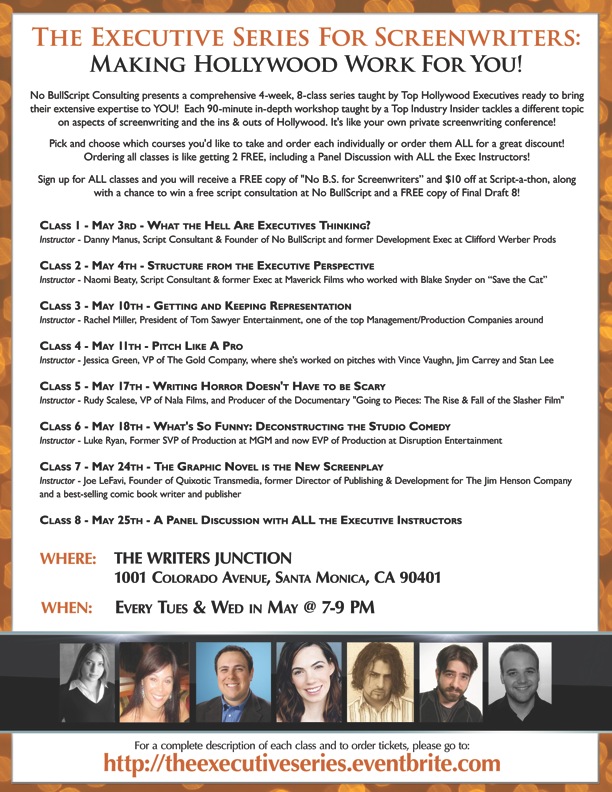
SIGN UP TODAY!!! ENTER DISCOUNT CODE “THEBOSI” OR “JUNCTIONWRITERS” FOR A 10% DISCOUNT IF YOU SIGN UP FOR ALL CLASSES!
-
What the Hell is High Concept?
April 7th, 2011By Danny Manus
I’ve had a number of writers email me and ask to discuss the term “high concept.”
I’ll confess…when I started working in this business as an assistant, and heard the term “high concept” over and over, at first I assumed it meant high budget. Then I thought it had something to do with drugs. But I quickly learned that a high concept project is a unique story that can be described clearly, succinctly and effectively in about one sentence – and you will understand and picture exactly what that movie is.
If your project is high concept, then that ONE sentence description should not only make us easily understand the story and make it clear what the demographic is and why it’s unique and original, but also make us picture the trailer, the poster, and the actor who would want to be cast.
If it’s a comedy, then your one line (and quite frankly even your title) should make it OBVIOUS that there are a ton of original, funny things that could happen. If you’re writing a thriller – it needs to be clear that the potential for great suspense and thrills is there. Horror, same thing.
Can your project do that? Don’t answer just yet.
High concept properties are more about the premise and idea than the characters and their personal struggles. More about visuals and hooks than deep narratives and emotions. But almost any movie can be described in one or two sentences – that’s not enough. The hook – what makes your concept original and different – also has to be really clear. And high concept properties should be appropriate for mass audiences (at LEAST 2 out of the 4 quadrants – male, female, young, old).
Technically, the film Kids can be described in one sentence – a group of inner city youths do drugs and have sex until they realize their actions can have horrific consequences. But what’s NEW about that? What’s high concept about it? What’s the mass appeal? Nada.
Ninety percent (90%) of writers fail because their concept just isn’t strong enough, original enough, or commercial enough. They are doomed from the start.
If your project is so intricate, so complex, so cerebral that no one will get it (and get it quickly) – then it’s not high concept. This doesn’t mean it’s not commercial – Inception was NOT high concept. But MOST studio films are. Why? Because they have to be able to be marketed well, and low concept material is much harder to market. There are very few studios who actually market low concept well. Fox Searchlight is probably the best in the business (Slumdog Millionaire, Black Swan, Little Miss Sunshine, etc). But most studios just don’t get it.
And neither do audiences. Audiences, by and large, are stupid and have no attention span. High concept material is pitch-driven. But if your pitch starts with “so the troubled protagonist had this horrible childhood and goes on this journey to find himself…blah blah blah” – it’s NOT high concept!
High concept pitches do not start with character and back story – they start with premise and action. If it takes 10 minutes to explain your story…that’s 9 minutes and 45 seconds too long. But if you can describe your story by simply saying “big shiny thing here now BOOM” – people will get it.
Comedies (especially R-rated and romantic comedies), action films, some horror, disaster movies, etc – these are the projects that are most often high concept. It’s harder to make dramas, teen movies, fantasy, and more intricate thrillers into high concept projects.
The very first purposefully high concept movies are often considered to be Jaws and Star Wars. Though the ultimate example of high concept is actually movies like Snakes on a Plane – you get everything you need to know in 4 words. Other great examples of high concept projects include Jurassic Park, Liar Liar, Groundhog Day, Armageddon, Wedding Crasher, Transformers, Air Force One, Speed, 40 Year-Old Virgin, Titanic, Home Alone, War of the Worlds, etc.
Great examples of low concept fare – Pulp Fiction, Sideways, Little Miss Sunshine, Fargo, Citizen Kane, Syriana, Garden State, almost anything by Robert Altman or Woody Allen, etc. You can see the difference in just the titles.
This doesn’t mean that your high concept project can’t tackle more in-depth issues or have an interesting story with lots of characters and plotlines. It just means that the hook to your script has to be so clear and original and understandable in one line that audiences will get what they are in for.
Studios largely work within the world of high concept. So if you want to be a studio writer, spend more time coming up with the best concept and premise with the most potential and commercial appeal instead of worrying if your character’s personal journey has a new plot point introduced on page 38. I hope that clears up what high concept material encompasses. Good luck and keep writing!
-
Keeping Logs in the Fire
April 7th, 2011By Danny Manus
You know what the number one key to being successful in this business is? Diversification! It’s about keeping as many logs in the fire as possible and knowing when and why one’s about to burn.
You all know breaking into Hollywood isn’t easy. And it’s even harder to stay in Hollywood once you’re here. You can’t just write a script and sit back and wait. Writing usually isn’t anyone’s first career – and if it is, I can promise you it’s not their ONLY one. But life experience (especially those hard knocks) is what enriches ones writing and makes the spoils of success that much sweeter. So I suppose my message to you is – most people have to do a lot of shit to be successful, so why should you be any different?
While working on a feature project called “To Oz,” which I set up at United Artists (but unfortunately is currently in turnaround), I became a bit of an expert on L. Frank Baum, the writer of all the “Oz” books (15 in total). It was said in the book The Real Wizard of Oz by Rebecca Loncraine that, “Baum could never concentrate on one thing at a time. His ambition-driven multiple interests skittered through his mind, pushing him in many different directions at once.”
Today, he’d probably get diagnosed with adult A.D.D. But perhaps he just knew what some writers today seem to forget – you have to be doing different things to improve and promote yourself and your talents. If you want to be a screenwriter, writing screenplays isn’t enough.
Would it surprise you to know that before he ever created a word of “Oz,” L. Frank Baum was an actor, a lubrication oil salesman, a photographer, an owner and player for a travelling baseball team, the owner of a general variety store, a writer of articles for several journals, creator of his own neighborhood printing press, and editor of a weekly paper? And he didn’t sit down and start writing Oz until he was in his 40s.
Ernest Hemingway was a reporter and ambulance driver before he started writing books. JR.R. Tolkien was a professor all his life who was in a writers group with C.S. Lewis, who in addition to writing Chronicles of Narnia and numerous other works, was a scholar, a teacher, and a noted Christian apologist. Before Lewis Caroll wrote Alice in Wonderland, he was a photographer, mathematician, poet, inventor, reporter, and studied for the priesthood.
They were constantly working TO something, but the key is – they were always working. They were always trying out new things, hungry for more knowledge, even if it wasn’t the thing they were most passionate about. They did a ton of OTHER stuff which helped create and influence their penchant and talents for writing.
Now I would never – EVER – draw any comparisons between them and myself, but I came out to Hollywood to be an Emmy winning TV Writer. And while that hasn’t really happened yet, in the more than eight years since my arrival, I’ve worked as an assistant, a development executive, a noted script consultant, a film producer, a production and post production coordinator, a casting assistant, a columnist, a teacher, and I’ve written over 115 articles in the last 2 years alone. Is it TV writing? No. But it all helps. It’s all stuff that develops my talents, gives me experience, and builds a name and a brand for myself – and that’s what you should all be doing.
Not selling your scripts yet? Ok, no problem. How about getting an article published in your local paper or a magazine or a newsletter. Or starting a blog and promoting it through social media. Or writing a short story. Or a one-act play. Or acting. Or taking an Improv comedy class and doing stand-up (something else I still wanna do). Or volunteering at a screenwriting conference to make connections.
You got a script? Great – so do 50,000 other people. So what ELSE you got? What else are you doing before you make your big break to make you stand out?
You need to find your niche. This is how you stay in the game. And you need to experiment with different things in order to do that. Try different things and see which one elicits the most passion and love from inside you. I hated production coordinating – hated it – but at least now I know that and I take that experience with me. I’m guessing L. Frank Baum didn’t love selling lubricating oil – but he did it and he grew from it.
Knowing how to market yourself is really important whether you’re a screenwriter or a small business owner or a…dentist. You have to know what makes you different. And as I’m learning, it’s not just about doing what you like – or even what you’re good at – it’s about seeing the big picture and learning how to do it all.
Being a multi-hyphenate is THE BEST WAY TO BREAK IN. I didn’t slip – that’s in caps for a reason. Many of today’s top acting, directing, writing, singing, dancing and producing talents are doing more than just ONE of those things.
With screenwriters, it’s not just writing scripts – it’s rewriting, polishing, editing, pitching, meeting, networking, researching, acting, directing, producing, and knowing enough of the business to know if what you’re writing is worth it. As I’ve learned with my own business, consulting isn’t just reading scripts and making notes – it’s also about blogging, teaching, lecturing, publicizing, advertising, tweeting, book publishing, contract negotiating, branding, web designing, connecting, selling, etc.
And I ALWAYS have more than one log in the fire.
So take a lesson from the masters – and from me – diversify. Keep as many logs in the fire as you can. Do, learn and experience every aspect of the business that you can, so that you are well-armed for when your big break comes.